

Search Blog
Hit enter to search or ESC to close
Trending Now


Parshas Shemos/Vaera - The Birth of a New Religion and the Age of Miracles
- Get link
- X
- Other Apps
Posts

Parsha Vayetze - The Right Time
Like Sarah and Rivka, the previous two generations of matriarchs, Rachel also appears unable to have children. While her sister Leah has a brood, Rachel bemoans her fate and demands Yaakov grant her children. Her husband replies harshly that he was not the one at fault or had denied her children. But was there a reason for Rachel's condition? If we examine the timeline, a potential answer quickly emerges. One that could have been apparent, but was not at the time. Yaakov makes an agreement with Lavan, the father of both Rachel and Leah, to work 7 years for Rachel's hand in marriage. Lavan famously cheats Yaakov and substitutes her sister instead. He then offers to let Yaakov also marry Rachel after eight days if he works for another 7 years. During these 7 years, Leah has seven children. It's an impressive record. During this same period, Rachel is unable to have children. Finally, when Yosef is born, Yaakov tells Lavan, "And it came to pass, when Rachel had borne Jos...
- Get link
- X
- Other Apps

Parsha Toldos - The Answer to a Prayer
Parshat Toldos begins with Yitzchak and Rivka, seemingly doomed to replay the tragedy of Avraham and Sarah by being unable to have children. The third pasuk tells us that "Yitzchak entreated G-d for his wife, for she was barren, and G-d accepted his prayer." While the pasuk makes no mention of Rivka praying, commentaries interpret Le'Nochach, a word in the pasuk, as meaning opposite, suggesting that they were both praying. Rashi comments that G-d accepted Yitzchak's prayer, not Rivka's, because he was the son of a tzaddik and she was the daughter of a wicked man. There are however obvious questions to be raised about this, not least of which is that it would imply that Yitzchak's prayers would be more effective than that of his own father's. There are a number of other answers as to why G-d might have listened to Yitzchak's prayer, rather than Rivka's. From a halachic perspective, men, not women, are obligated in the biblical command to have chi...
- Get link
- X
- Other Apps
Pesach - Four Questions and Four Sons
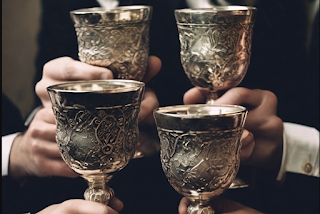
Pesach revolves around the number four. From the four expressions of liberation (arba leshonos shel geulah), to the four cups of wine, the four questions and the four sons, we celebrate surrounded by fours. But is there a connection between the two key educational dialogue elements of the seder: the four sons and the four questions? The four sons, righteous, wicked, simple, and the one who cannot even ask, serve as a kind of mission statement for the haggadah's approach to a multi-dimensional seder experience that reaches both the ignorant and the wise, who have their own questions. The four questions or the Ma Nishtana, are the first questions taught to a child, the she'eino yodea lishol or the one who cannot yet ask on his own, to ask about the differences between the night of Pesach and the ordinary night. It is possible to link the four sons to the four questions and in that way make sense of some of the answers to the four sons which can appear puzzling or abrasive. Take ...
- Get link
- X
- Other Apps

Parsha Bo - How Pharaoh Tried to Stop Pesach
As the final plague, the death of the first-born, approaches, Moshe warns Pharaoh that the final plague will kill all the human first-born and "all the first-born of cattle". (Shemos/Exodus 11:5) The devastating death of the "all the first-born in the land of Egypt shall die, from the first-born of Pharaoh that sit upon his throne, even unto the first-born of the maid-servant that is behind the mill" is obvious. What exactly does the death of all the first-born of cattle add to this, especially since previous plagues, particularly Dever, a plague that killed the Egyptian cattle, already inflicted serious losses on the animals? When G-d first warns about the death of the first-born, He does so long before in Shemos 4:22-23 even before Moshe has arrived in Egypt. "And thou shalt say unto Pharaoh: 'Thus saith the LORD: Israel is My son, My first-born. And I have said unto thee: Let My son go, that he may serve Me; and thou hast refused to let him go. Behold,...
- Get link
- X
- Other Apps

Parshas Vayishlach - Jacob Wrestles an Angel for his Name
One of the most mystifying, perhaps the most mystifying incident, in the Torah comes at the start of Parshas Vayislach. Yaakov, preparing for a potentially fatal confrontation with his brother and rival Esav, issues a heartfelt plea for salvation to G-d. And, seemingly in response, an angel shows up to fight not Esav, but Yaakov. The prolonged wrestling match ends with Yaakov (Jacob) limping and the angel beaten to a stalemate. Yaakov demands a blessing from the angel in exchange for releasing him, and the angel blesses or foretells his new name, not Yaakov but Yisrael (Israel), and yet the new name is hardly used. What in the world is going on here? Let's start by considering what a name, especially in the biblical sense, is. It's a description of someone's fundamental quality. Yaakov's name, literally heel, is uniquely derogatory and emerges from his birth clutching at Esav's heel. The new name, Yisrael, is a triumphant warrior name, For You Have Contended With ...
- Get link
- X
- Other Apps

Parsha Miketz - Don't Follow Your Dreams
Parshas Miketz begins with a dream. Previously, Vayetze had begun with a dream and Vayeshev had begun and ended with dreams. But there's a substantive difference between the earlier dreams, those of Yaakov, and the later dreams involving Yosef. In Yaakov's dreams, G-d or an angel had explained their meaning or purpose to the patriarch, whereas Yosef' had to explain his own dreams and those of others. As the embryonic Jewish people moved closer to the point of exile, the connection with G-d appeared to grow tenuous. Until Moshe, Yaakov would be the last Jew whom the Torah describes G-d speaking to. In the Egyptian exile, the Jews were no longer able to hear G-d. Yosef's dreams, filled with abstract symbols, but without words, were the beginning of that exile in more ways than one. The dreams would help bring on a physical exile, but they were also the symbols of a spiritual exile from the close connection of direct conversations and clear messages that Avraham, Yitzchak,...
- Get link
- X
- Other Apps

The Chanukah of Chanukah - Why We Only Celebrate the Dedication of a Defiled Temple
What is Chanukah specifically? Many discussions about Chanukah begin with the artificial distinction between the military victory and the miracle of the oil that burned for 8 days. This distinction is wholly artificial because the war had been fought by a priestly family over the desecration of the sacred service and concluded with the purification of the Temple. The military campaign and the reclamation of the Temple are the means and the end. The miracle of the oil was the achievement of the goal for which the battle had been fought. To separate the two as if they belonged to two different world is like separating the blowing of the shofar at the Western Wall from the Six Day War. Both were miracles, but one was the moral climax of the miracle. The miracle of the menorah was, in the old military slogan, "why we fight". And yet Chanukah, the name of the holiday, references neither the battle nor, explicitly, the menorah. Chanukah simply means dedication. The first dedication...
- Get link
- X
- Other Apps