

Search Blog
Hit enter to search or ESC to close
Trending Now


Shabbos HaGadol - The Hearts of the Fathers and the Sons
- Get link
- X
- Other Apps

Posts

Parshas Toldos - Love and Judgement
The Jewish idea of love is defined as Ahava Sheineah Teluiah BaDavar or A Love That Does Not Depend on a Thing. "Any love that is dependent on something--when the thing ceases, the love also ceases. But a love that is not dependent on anything never ceases. What is [an example of] a love that is dependent on something? The love of Amnon for Tamar. And one that is not dependent on anything? The love of David and Yonatan." ( Pirkei Avot 5:16 ) Is a love that is not dependent on anything truly not dependent on anything? It's not dependent on anything impermanent. It goes deeper than any surface matter. What is an example of that? We can look to G-d's love for Avraham for the paradigm. "For I have known him because he commands his sons and his household after him, that they should keep the way of the Lord to perform righteousness and justice, in order that the Lord bring upon Avraham that which He spoke concerning him." Bereishis/Genesis 18:19 Th...
- Get link
- X
- Other Apps
Parshas Vayislach - The Hunter and the Shepherd
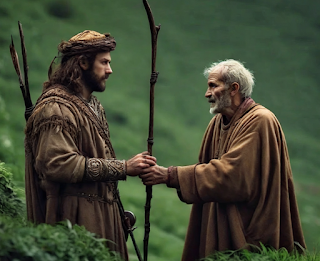
Two parshas ago many wondered why Yitzchak would have tried to give his blessing to Esav. The answer to that can be seen by working backward from the blessing. Yitzchak blesses the son he thought was Esav by saying, "The smell of my son is as the smell of a field which the LORD hath blessed." The blessing that he goes on to give him is the blessing of the field. "God give thee of the dew of heaven, and of the fat places of the earth, and plenty of corn and wine. Let peoples serve thee, and nations bow down to thee. Be lord over thy brethren, and let thy mother's sons bow down to thee." To secure this blessing, Yitzchak had sent out Esav to take his weapons and hunt him down a meal. Esav was the hunter, the one who went out and caught game, while Yaakov dwelt in tents, watching over the flock as a shepherd. While Esav goes to hunt meat, Yaakov slaughters tame animals for the meal. Yaakov is the shepherd. Esav is the hunter. But Yitzchak chose to favor the...
- Get link
- X
- Other Apps

Parshas Vaera - The Joy of the Joke
Yitzchak, the long-promised son of Avraham and Sarah, has a seemingly unflattering name. Instead of being named after some divine virtue, his name simply means "Laughed" commemorating the response of Avraham and Sarah when they were told by G-d that they would have a son at such an advanced age. When Avraham is told by G-d that he will have a son, he laughs inwardly, and asks G-d only that Yishmael should repent and turn righteous. When Sarah is informed by an angel, she laughs at the idea of having a child at such an age. Why then give their miracle child a name commemorating their skepticism? Choosing the name, Sarah says, "Tzhok Natan Li Elohim", G-d gave me laughter, which here means joy. G-d gave Sarah reason to rejoice, her initial skeptical laugh of unbelief becoming a laugh of joy at the impossible. "And everyone who hears of it, will rejoice for me." We laugh naturally at things that are ridiculous. We laugh because they are outside the no...
- Get link
- X
- Other Apps
Parshas Noach - World Full of Robbery
The most frequent interpretation of Hamas, the reason that G-d declares that the earth must be wiped clean of all living things, aside from Noach and the birds, insects and animals in the ark, is robbery. The famous Gemara says that the verdict was sealed only over Gezel or theft. The question is why was theft such an extraordinary crime that it necessitated wiping out not only mankind, but also all life on the surface, for it's explicitly stated that all life had become corrupted. Animals have no concept or legal standing when it comes to property. Furthermore why is this suddenly an issue that had not been mentioned previously during earlier generations which did not seem to have the same crime problem? To understand that last point, let's go back to the two earlier sins. First Adam and Chava took from the Tree of Knowledge that they had been forbidden to eat from. Second, Kayin, unlike his brother, brought a sacrifice to G-d that was not from the best and resented G-d ...
- Get link
- X
- Other Apps
Parshas Chukas - The Word and the Stone
Moshe being barred from entering the Land of Israel is a pivotal moment in Jewish history and also one of the more baffling ones. Why is Moshe kept out of the land? What is the real difference between striking a rock and speaking to the rock? Is there a practical difference beyond G-d's command? And why was Aaron, who appears to have little involvement, also dragged into this? To begin with, let's examine the two incidents. First early on, not long after leaving Egypt, Moshe is confronted by a crowd demanding water. G-d tells him to strike the rock. He does it. Water comes out. Second, rather late in the journey, as they approach the Land of Israel, the assembly demands water. G-d tells him to speak to the rock. He strikes it instead. Let's begin by comparing and contrasting the two incidents. Both times Moshe is told to take his staff. But the second time Aaron is included in the command, the first time he is not. The early plagues and miracles were carried out by Aaron us...
- Get link
- X
- Other Apps

Yiftah and G-d - The Importance of Distinctions
The story of Yiftah's Daughter is one of the more famous and tragic events in Shoftim, Judges, which is already full of tragic and dreadful events. On the surface it appears to be the tragedy of a man making a foolish vow. There appears to be no larger context to it. But to understand the meaning of the story, we need to go back to the beginning. Yiftah (Jeptah) is called back to lead the fight against the Ammonite invaders and he writes a letter to the King of Ammon, which is one of the first examples of diplomacy. While Yiftah's background might make you think that he would like a fight, he tries to talk things out with the Ammonite king. After relating the story of how the disputed territory came into Israel's possession, he tries to turn all that history into something the King of Ammon can relate to. "Wilt not thou possess that which Chemosh thy god giveth thee to possess? So whomsoever the LORD our God hath dispossessed from before us, them will we posses...
- Get link
- X
- Other Apps
Chanukah - One Spark
The battle of the Maccabees and the miracle of the oil that lasted for eight days are often treated as discrete phenomena. What after all does a military victory have to do with oil burning for eight days. The Al Hanissim prayer hardly mentions the miracle of the oil, instead it focuses on the military victory in the following terms. "Gibborim beyad Halashim veRabim BeYad Meatim", the strong fell into the hands of the weak and the many into the hands of the few. Only then could the lights be lit in the holy temple. Last week's parsha, Parshas Vayeishev begins with a curious Rashi. After the previous parsha's conclusion had described the descendants of Edom and all the kings of Edom who had ruled before a single king had ruled in Israel, Parshas Vayeishev mentions the Toldos of Yaakov as being Yosef. And the Rashi uses a parable to explain that. A flax merchant led a caravan of camels through the street loaded with flax. A blacksmith standing by the side of his sma...
- Get link
- X
- Other Apps